Showing posts with label on publishing. Show all posts

Monday, November 7, 2016

Finding My Insanity and Other News

Cover mock-up, the titled has changed to "Beyond Insanity"

I'm well on track for NaNoWriMo. In fact I should be finished with the draft by Thanksgiving. 


I'm not doing a novel, nor 50,000 words though. I'm doing about 20,000 for another anthology of short stories (see left). It should be released on Valentine's Day 2017 if all goes as planned.

Meanwhile, I'm working on a small audio project that has nothing to do with writing (it's a surprise).

And I'm working at the writing center (Harbor House). I'll be teaching a class, "What Publishing Path is Right for You?" on Nov. 19 (see the Harbor House website for more info on the class and other offerings for NaNoWriMo and more).


Monday, June 13, 2016

Marketing is the Hardest Part of Self-Publishing

P.T. Barnum, showman, circus promoter

P. T. Barnum said, "Without promotion, something terrible happens...nothing! "


Marketing is by far the hardest thing I do as a writer. I put a lot of effort into it, but I must suck at it, because it just doesn't work very well. I miss about 90% of the shots I take and I can't figure out what the 10% is that is working.


From what I read, I do a lot of the "right" things, but I'm not seeing results that others do. Is it poor writing? Shoddy covers? Bad reviews? I don't think so.

Those who've read my do books like them, it's just that few people read them (lol). I think I must be missing my audience--not getting my efforts in front of the right people. And therein lies the rub, does it not?

I either do not know where to find them, how to get in front of them, or do not have the money (or am unwilling to risk it) to do so. I don't like to throw money around just to see if something might happen. And when I have I have often been burned.

For example:

I have a book titled Lights, Camera, Worship! that once did well. I was on a speaking circuit at the time and I sold them after my talks at various conferences. But the book got dated, so I revised it and reissued it.

I ordered 200 copies and paid big bucks for a table to launch the book at Worship Northwest--a gathering of hundreds of worship leaders (my perfect audience). I also paid for an ad in a Christian newspaper along with a nice article about the launch. And...nothing happened. I sold maybe two books. (Anyone want to buy a copy? I still have a few on hand.) The weird thing is, every once in awhile I see them being bought online. Could it be the SEO?

And yet, my Big Papa Zee's Cajun and Caribbean Cookbook, sells fairly online (especially around Mardi Gras and Christmas) without any promotion at all. SEO?

Click to enlarge for detail.
Then, I have another book, Plays & Sketches for Schools and Churches, that is a lovely book with stellar reviews from a handful of industry professionals. I have sent out dozens and dozens of promo copies to Christian schools. Not a peep. Not a single sale.

Anyway, there are very few authors I know who have a real clue. Many are in the same boat as I. Many of us find ourselves adrift on the SS Clueless. I know this because it's something we all talk about and ask each other about. And those few who are doing something that is working for them, well...

Let's just say that it's hit and miss, sheer dumb luck, or being in the right place at the right time. Who knows? What works for one at any given time might not work for someone else or at another time. There is no one magical solution with one size that fits all. Something mysterious is at work.

So why bother? 

Because without effort you surely will not see results. If you aim at nothing you will hit it every time. Do you think books become bestsellers simply by chance? No, they do not. It may seem so, but happenstance plays a very small part.

Great books and terrible books rise to the top by orchestration.

"OOYL, Once Only You Live"
So, you must have a plan. You must make an effort. And you must "sacrifice your firstborn to the gods of literature" (just kidding). Research, ask questions, experiment, and try.

Yoda was wrong, there is a try...and a try, try again. 


Begin with all the free things (like social media and press releases) and, if you have some money, spend it wisely thereafter. Target market (especially when it comes to spending money). Print ads are expensive, but, if you have a niche, an ad in the right publication might prove fruitful.

Public speaking gigs seem to do a lot of good for those writers that do that sort of thing. It helps build a platform and gets you in front of buyers. But I know that's not for everyone and it does take a lot of work to get the gigs.

And whatever you do, be sure to do it well. Quality counts.

Well, I wish I could give you more, but I have no "secrets." Besides, what works for me might not work for you. But let's keep sharing ideas anyway. I'd love to hear from you.

BTW, my new books are: Chicken Poop on my Sole, The Bayou Boys Adventures omnibus, and Hell, Heaven and Back. Wanna buy a book?

Sunday, February 14, 2016

The Page is Turning: On the Future of the Bookstore

The Espresso Book Press

Anyone who buys or sells books these days is talking. They're talking about the future of books and book sellers. And they've been talking for a while now. 


Meanwhile, changes have been taking place.


We've seen many of the mega "brick and mortar" bookstores close; Barnes and Nobel, Borders and others have shut their doors across the nation.

Still, others (like Powell's and Books-a-Million) somehow manage to hold on.  Some small indie book retailers continue to do business, while others close up shop. We can probably all name a favorite indie bookstore that has disappeared.

Many blame the advent of e-readers and online shopping (Kindle/Amazon), which could well be the case. However, that doesn't explain why some stores manage to thrive while others cannot survive.

Certainly, Amazon has made a major effort to undermine (by underselling) the competition and has, therefore, contributed to the demise the local bookstore. One (now closed) retailer I know said, "Not a day went by when someone didn't say to me, 'Oh, I'll just buy that online.'" (As a side note I must add: How evil is that!?)

And now that the local competition has been driven into the ground it seems that Amazon has plans to open multiple "brick and mortar" bookstores nation-wide; having opened their pilot store in Seattle with a measure of success.

Still, for their version of the local bookstore to work, wouldn't it have to be quite different from the traditional model? What was "bad" or "wrong" with the traditional bookstore? And what's "good" about online shopping? And, finally, how can the two be integrated or hybridized to make a better product?

If Amazon (or anyone else, for that matter) wishes to succeed on the local scene they're going to have to offer a retail experience that combines the best of both worlds and becomes something altogether new and better.

One of the major concerns for any bookstore, big or small, is what to stock. No matter how big you are there are always more books than you have room for. In the USA alone there are more than 300,000 new titles published per year--that's printed books and does not take into account e-book-only titles. Amazon currently lists 32.8 million titles (hardback and paperback) and there's a new book added every five minutes! (Keep in mind that many of these are no longer traditionally published.) You can have that kind of volume in virtual retail, but not in a physical space.

Traditionally, retail stores stock only what sells well. At least they try to. There's a whole model for the traditional book business that, for reasons of length, I won't go into here. (Perhaps at another time.) Suffice it to say that if books don't sell the publisher buys them back and that, in the past, the publishers assumed all the risk (which is why they are reticent to publish just any old thing).

BUT, the industry has been challenged by the advent of e-books and the self-publishing impetus. And Print on Demand (POD) has revolutionized the book business.

So, if variety is indeed the spice of life, and you can stock only so many books, a hybrid is the only reasonable answer. Two guiding truths will shape the future of booksellers: One, in order for a book to sell it has to be seen (exposure) and two, in order for a seen book to be sold it has to be deliverable, and the quicker the better (immediacy). Exposure and immediacy means that the browsing and buying experience must go hand-in-hand.

If you know what you want, you need to find it. If you don't know what you want, you need to find something that appeals to you. Basically, that's why online shopping works so well, you can search by title or author or by any other set of parameters (search terms) you choose. You can either find exactly what you wanted or get a list of suggestions that might fill the bill. That kind of browsability must be available in the new book-shopping experience. But then, the problem with shopping online is that when you find an item you want to buy you have to wait for it.

In order for the shopping experience to be completed (immediate product delivery) what has been sought must be bought and then walked out the door right then and there.

Enter the POD Book Press (see photo above). Those familiar with CreateSpace know that your indie/self-published book isn't printed until it's ordered. Once ordered only the copies requested are printed and shipped. No stock on hand, no wasted paper sitting around in your garage or taking up shelf space. What's more every book added to the data-base--"out-of-print," rare, new, classic--will always be available (until the dystopian future, anyway).

Now imagine that POD Press in a bookstore like Powell's. You walk in, browse a kiosk for the book(s) you want, select them on the touch-screen, slide or bump your credit card, touch the "complete order" button and then go order a cup of joe or browse the internet. Five to ten minutes later you pick up your book hot off the press--every bit the quality you've always expected.

Think what this means for the traditional publishers (willing to survive the new model): less, risk, no waste, no back-orders, less overhead and more authors. Think, too, what it means for the indie-authors: more exposure, more availability, more sales and less footwork.

It's the model I foresee. The only model that will work well for publishers, authors, booksellers and readers. We live in a microwave, fast-food, instant gratification society and, in this model, everyone gets what they want...when they want it.

Click here to learn more and see a VIDEO of an Espresso Book Press in operation.

Monday, March 3, 2014

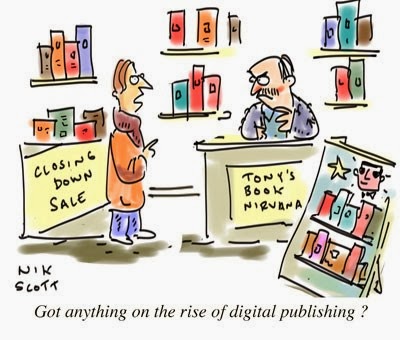
The End of Publishing as we Know it?

Most everyone knows that the publishing industry is changing--even struggling. Certainly this is known by everyone who writes or publishes.

There are many signs.


Independent and corporate bookstores are closing. Publishers are consolidating. Amazon is growing. ebooks and self-publishing are quickly taking over the market.

Everywhere you see the publishing industry (publishers, editors and agents) condemning the indie market, railing against the "unchecked" movement, decrying a "gateless" freedom where anyone wanting to can now publish a book. Such prattling is a sure sign of fear on their part as cash flow continues to dwindle.

The tendency certainly begs the question: "Is this good or bad?"

That depends.


On the one hand publishers have always served as "gatekeepers," regulating the quality of grammar and "worthiness" of what the public reads. In so doing they have stifled voices and thought, but kept the "standard." They have offered a sort of "badgeing" or approval service to the public. But they have also taken the lion's share of the profits and also the brunt of the risk. The bulk of authors either get rejected or, if published, see very little of the profits (royalties rarely pay more than 12%).

On the other hand, when there are no gatekeepers, anyone can have a voice. Today people are less trusting of corporate authority than in the past. They don't want authority figures telling them what they can and cannot do. They are reticent of accepting fed information. Fewer and fewer people trust the media industry and many feel it is biased. Citizen journalism, by way of the web, is on the rise as it has been since the 90s. Most people trust what their friends say before they trust the media.

This also reflects on the publishing industry. People are now saying "you can't decide for me what is worthy of reading," and they take their friend's advice over what marketing campaigns push at them. In fact, publishers are trending toward throwing their hands up when it comes to marketing--offering less and less to new authors. Often what efforts they do make do little to boost their bottom line.

You heard it said that you can lead a horse to water, but you can't make him drink. The same is true for readers: You can lead a person to a book, but you can't make them read it. No amount of marketing is going to get people to read. Word of mouth is the most effective means of advertising.

So, on the one hand you have publishers touting their "filtering" philosophy, and, on the other, you've got a public saying we don't need you.

The industry hates the indies.


At first they said it wouldn't fly and now mock it, hoping it will go away. But it won't. It grows. And most indie books aren't nearly as bad as they say they are. Some are, but many are quite good.

Authors are wising up, too. They know they don't need to face endless rejection, that they can earn more in royalties, and that they can get books to market when they want (not wait years for the corporate wheels to turn).

Furthermore, it would be wise for the publishing industry to take the initiative to reinvent themselves to embrace the movement rather than buck it. But they won't, because, even though the trend may see their demise, they are greedy. Before you know it, it will be too late.

Publishing is no longer for the elite few, but for everyone with a voice.

http://www.theguardian.com/books/2014/feb/28/waterstones-james-daunt-interview-books-bookshops-ebooks